
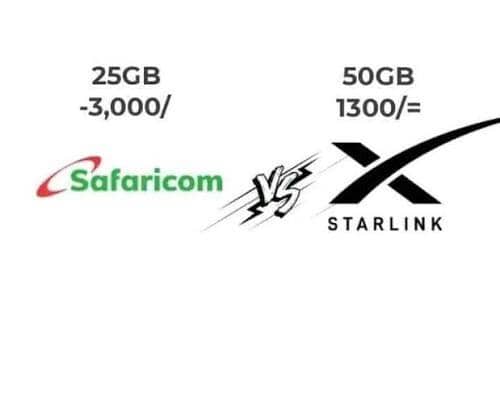
Choosing the right home internet provider in Kenya has become more exciting than ever. Two of the biggest options are Starlink, the satellite internet service from SpaceX, and Safaricom Home Fibre, Kenya’s leading fibre broadband service.
While both deliver fast internet, they use different technologies and cater to different users. Starlink offers satellite connectivity almost anywhere with a clear view of the sky, while Safaricom Home Fibre delivers internet through fibre-optic cables in areas where its network is available.
So, which one should you choose?
This comparison breaks down speed, pricing, installation, gaming performance, reliability, and overall value.
Starlink Overview
Starlink is a low-Earth orbit (LEO) satellite internet service developed by SpaceX. It is designed to provide high-speed internet to homes and businesses, including rural and remote areas where fibre is unavailable.
Key Features
- Nationwide coverage across Kenya
- Self-installation
- Unlimited data on residential plans
- Suitable for remote locations
- Portable options available on select plans
According to Starlink’s official Kenya plans, Residential Lite costs KSh 4,000 per month, while the standard Residential plan costs KSh 6,500 per month.
Safaricom Home Fibre Overview
Safaricom Home Fibre is a fixed broadband service that delivers internet through fibre-optic cables directly to your home.
It is available in many urban and peri-urban areas but depends on fibre infrastructure being installed in your neighborhood.
Current plans include:
- 40 Mbps – KSh 2,999/month
- 60 Mbps – KSh 4,100/month
- 150 Mbps – KSh 6,299/month
- 500 Mbps – KSh 12,499/month
- 1 Gbps – KSh 20,000/month
Starlink vs Safaricom Home Fibre Comparison
| Feature | Starlink | Safaricom Home Fibre |
|---|---|---|
| Technology | Satellite | Fibre optic |
| Coverage | Almost nationwide | Fibre-covered areas only |
| Monthly Cost | From KSh 4,000 | From KSh 2,999 |
| Installation | Self-install | Technician installation |
| Hardware Cost | One-time purchase of Starlink kit | Router typically provided during installation |
| Latency | Good | Excellent |
| Gaming | Good | Excellent |
| Weather Impact | Slightly affected during severe weather | Rarely affected by weather |
| Best For | Rural and remote homes | Urban homes and businesses |
Speed Comparison
Safaricom offers fixed-speed fibre packages ranging from 40 Mbps to 1 Gbps, making it ideal for heavy users, businesses, and large households.
Starlink speeds vary depending on network conditions and location but generally provide fast broadband suitable for streaming, video calls, remote work, and gaming.
Winner: Safaricom Home Fibre
Coverage
This is where Starlink has a major advantage.
Starlink
- Works in most parts of Kenya with a clear view of the sky
- Ideal for rural homes, farms, lodges, and remote businesses
Safaricom Home Fibre
- Available only where fibre infrastructure has been deployed
- Coverage is strongest in towns and cities
Winner: Starlink
Installation
Starlink
- Purchase the hardware kit
- Set up the dish yourself
- Activation takes only a short time once the kit is installed
Safaricom Home Fibre
- Requires fibre availability in your area
- Installation is carried out by technicians after your application is approved
Winner: Starlink
Gaming Performance
Online gaming depends heavily on latency (ping).
Because fibre connections generally have lower latency than satellite internet, Safaricom Home Fibre provides a better experience for:
- Competitive gaming
- Cloud gaming
- Fast-paced multiplayer games
- Live streaming
Winner: Safaricom Home Fibre
Video Streaming
Both services comfortably support:
- Netflix
- YouTube
- Disney+
- Showmax
- Video conferencing
If you regularly stream 4K content across multiple devices, higher-tier Safaricom fibre packages offer more consistent performance.
Winner: Safaricom Home Fibre
Reliability
Safaricom fibre delivers a stable connection where fibre infrastructure is available, though outages can occur due to cable faults or maintenance.
Starlink is independent of terrestrial fibre cables, making it valuable in areas prone to fibre cuts. However, severe weather or obstructions can occasionally affect signal quality.
Winner: Tie
Pricing
Starlink
Pros
- Access almost anywhere in Kenya
- Unlimited residential options
- Excellent for underserved areas
Cons
- Higher monthly subscription
- Upfront hardware purchase required
Safaricom Home Fibre
Pros
- Lower entry-level monthly cost
- Very high speeds for the price
- No need to purchase expensive satellite equipment
Cons
- Limited to fibre-covered locations
Winner: Safaricom Home Fibre
Pros and Cons
Starlink Pros
- Nationwide availability
- Great for remote locations
- Quick self-installation
- Reliable where fibre is unavailable
Starlink Cons
- Higher upfront equipment cost
- Performance can vary slightly with weather and obstructions
Safaricom Home Fibre Pros
- Lower latency
- Excellent value
- Faster top-end speeds
- Ideal for gaming and streaming
Safaricom Home Fibre Cons
- Not available everywhere
- Requires fibre infrastructure
Which Should You Choose?
Choose Starlink if you:
- Live in a rural or remote area
- Cannot access fibre internet
- Need reliable connectivity for a farm, lodge, or off-grid home
- Want internet almost anywhere in Kenya
Choose Safaricom Home Fibre if you:
- Live in a fibre-covered area
- Want lower monthly costs
- Play online games
- Need ultra-fast speeds for multiple users
- Work from home with heavy internet usage
Frequently Asked Questions
Is Starlink faster than Safaricom Home Fibre?
Not necessarily. Safaricom offers fixed packages up to 1 Gbps, while Starlink speeds vary depending on network conditions and location.
Is Starlink available everywhere in Kenya?
Starlink is available across most of Kenya, provided there is a clear view of the sky and service capacity is available in your area.
Which internet is better for gaming?
Safaricom Home Fibre generally delivers lower latency, making it the better option for competitive online gaming.
Is Starlink worth it?
Yes, especially for users in areas without access to fibre or other reliable broadband options.
Which is cheaper?
Safaricom Home Fibre has a lower starting monthly price and does not require the significant upfront hardware investment needed for Starlink.
Final Verdict
The Starlink vs Safaricom Home Fibre decision comes down to where you live.
If you have access to Safaricom Home Fibre, it is the better overall choice for most households thanks to its lower prices, faster fixed-speed packages, lower latency, and excellent performance for gaming, streaming, and remote work.
However, if you live in a rural or underserved area where fibre is unavailable, Starlink is a game-changing solution. Its nationwide satellite coverage makes high-speed internet accessible in places that traditional fibre networks cannot reach, making it one of the best connectivity options for remote homes and businesses in Kenya.